Introduction
Are your current IPTV service providers delivering the quality and reliability you expect in 2025? If you’ve experienced frozen screens during crucial sports moments, endless buffering during prime-time shows, or inconsistent server performance, you’re not alone. Millions of cord-cutters worldwide are navigating the complex landscape of IPTV subscriptions, seeking providers that offer seamless streaming experiences without the traditional cable hassles.
The global IPTV market has exploded to over $94 billion in 2025, with more than 320 million households abandoning traditional broadcasting for internet-based television. This massive shift reflects changing consumer preferences: affordable pricing, extensive channel lineups, on-demand flexibility, and multi-device compatibility. However, not all IPTV service providers are created equal. Server stability, anti-freeze technology, and streaming quality vary dramatically across the industry.
This comprehensive guide examines the best IPTV service providers available in 2025, breaking down technical specifications, performance benchmarks, and user experience factors. Whether you’re a first-time IPTV buyer, a tech enthusiast exploring cutting-edge streaming solutions, or a reseller evaluating reliable partnerships, this ultimate guide provides data-driven insights to help you make informed decisions. We’ll explore everything from core IPTV technology and setup procedures to provider comparisons and common pitfalls to avoid.
What Are IPTV Service Providers?
IPTV service providers deliver television content through internet protocol networks rather than traditional cable, satellite, or terrestrial broadcasting methods. Unlike conventional TV services that transmit signals through coaxial cables or satellite dishes, IPTV streaming leverages your existing internet connection to deliver live TV channels, video-on-demand content, and interactive features directly to your devices.
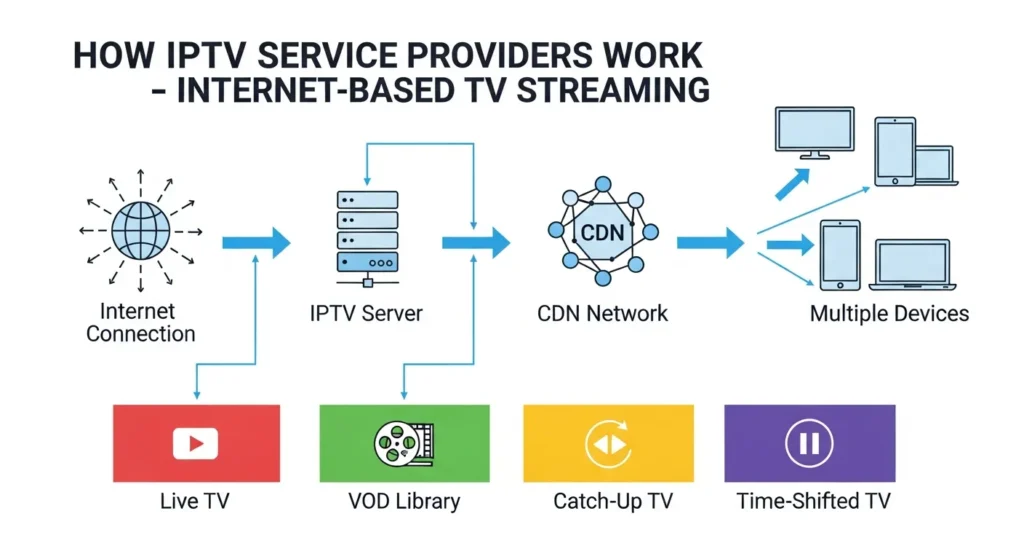
How IPTV Works: When you select a channel or program, your request travels to the IPTV server, which retrieves the content from its source and streams it back to your device in small data packets. This streaming method allows for greater flexibility, lower infrastructure costs, and enhanced personalization compared to traditional broadcasting.
Types of IPTV Services:
Live TV IPTV provides real-time broadcasting of television channels, similar to traditional cable but delivered over the internet. This includes sports events, news broadcasts, and scheduled programming.
Video-on-Demand (VOD) offers access to extensive libraries of movies, series, and documentaries that you can watch anytime. VOD libraries from premium IPTV service providers often contain 10,000+ titles.
Catch-Up TV allows viewers to watch previously aired content from the past few days or weeks, while Time-Shifted TV enables pausing, rewinding, and fast-forwarding live television.
Why People Switch to IPTV in 2025: Cost savings represent the most obvious advantage—average monthly IPTV plans range from $10 to $25, compared to traditional cable packages that often exceed $100 monthly. Channel variety is another significant draw, with many IPTV service providers offering 5,000 to 20,000+ international channels covering every conceivable interest and language. Device flexibility allows subscribers to watch content on smartphones, tablets, smart TVs, streaming boxes, and computers simultaneously.
How IPTV Service Providers Work: Core Technology
Understanding the technology behind IPTV service providers helps you evaluate performance differences and make smarter purchasing decisions.
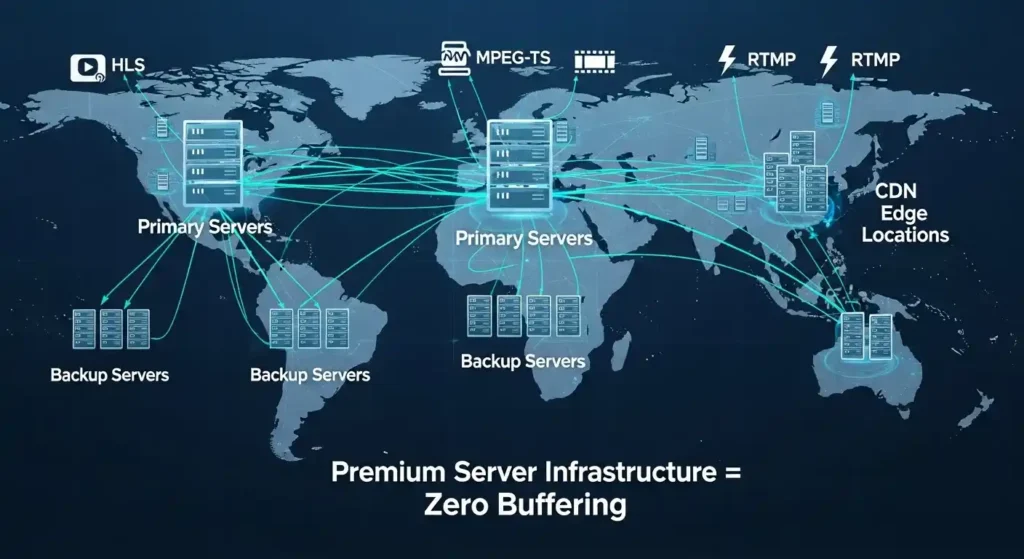
IPTV Servers form the backbone of any IPTV service, storing and distributing content to users. Premium providers utilize multiple server locations worldwide to ensure redundancy and minimize latency. Content Delivery Networks (CDN) consist of distributed server networks that cache content closer to end-users, reducing buffering and improving streaming quality.
Streaming Protocols manage how data travels from servers to your device. HLS (HTTP Live Streaming) is the most widely used protocol, offering excellent compatibility and adaptive bitrate streaming. MPEG-TS handles live TV streaming with reliable transmission, while RTMP provides low latency for live broadcasts.
Video Compression Technology includes H.264 for standard HD content (3-8 Mbps for 1080p) and H.265 (HEVC) for next-generation compression that delivers the same quality at half the bitrate—essential for 4K streaming.
Anti-Freeze Technology distinguishes premium IPTV service providers through adaptive bitrate switching, buffer management, and multi-server fallback systems that detect connection issues and automatically adjust streaming parameters.
Electronic Program Guide (EPG) provides channel schedules, program information, and navigation interfaces. Quality EPG systems update hourly and include detailed program descriptions, episode information, and thumbnails.
Setup Time & Ease of Use Across IPTV Providers
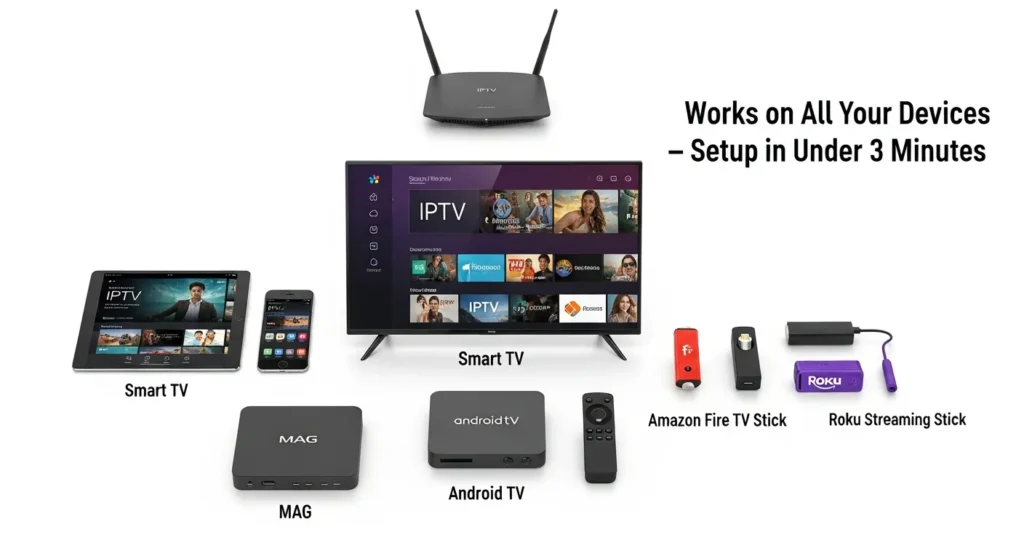
One of IPTV’s most attractive features is its remarkably simple setup process. Unlike traditional cable installations requiring technician visits, most IPTV subscriptions activate within 1-3 minutes once you receive your login credentials.
Device Compatibility: Modern IPTV service providers support Smart TVs (Samsung, LG, Android TV), streaming devices (Firestick, Roku, Apple TV, Chromecast), Android and iOS devices, MAG boxes, and computers across all operating systems.
Average Setup Duration: The typical IPTV installation process takes 2-5 minutes total—30-60 seconds for app download, 30 seconds for credential entry, 30-90 seconds for playlist loading, and 1-2 minutes for channel testing.
Performance Variation: Premium providers with robust server infrastructure deliver instant channel switching (under 2 seconds), while budget services may experience 5-10 second delays. Server response times range from 50ms for top-tier services to 200-500ms for overcrowded servers.
Optimization Tips: Enable 5GHz Wi-Fi networks rather than 2.4GHz to reduce interference. Use Ethernet connections for streaming devices whenever possible. Ensure your internet connection provides at least 25 Mbps dedicated bandwidth for 4K content. Avoid VPN usage unless your IPTV provider explicitly recommends it.
Step-by-Step IPTV Setup Instructions
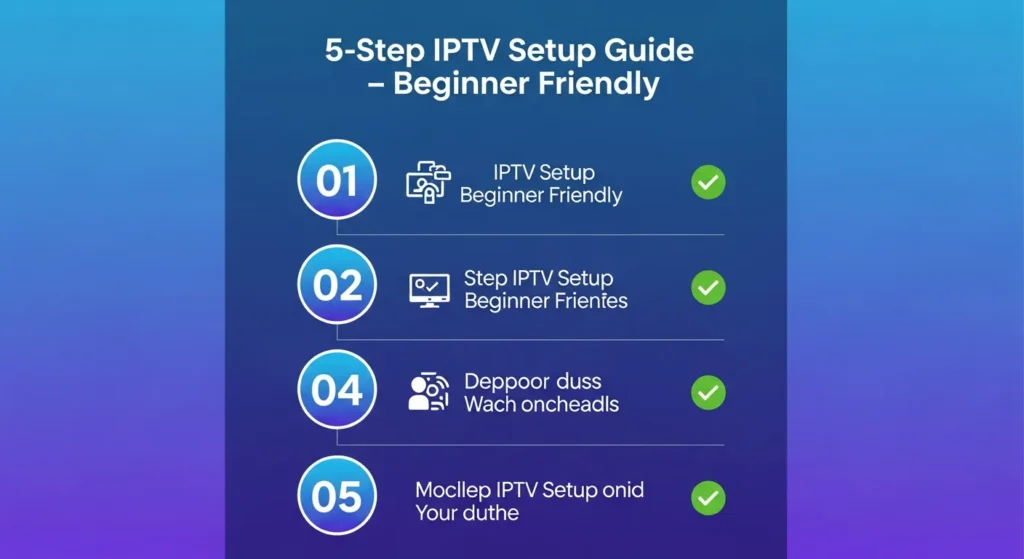
Step 1: Choose Your IPTV App
Popular IPTV apps in 2025 include IPTV Smarters Pro (user-friendly with EPG support and parental controls), TiviMate (premium player with advanced customization), XCIPTV Player (versatile with built-in EPG and VOD), and Perfect Player (lightweight for Android and Windows).
Pro Tip: Choose apps that support hardware decoding and offer buffer settings adjustment for smoother playback.
Step 2: Enter M3U URL or Xtream Codes
For M3U URL Method, copy the playlist URL from your provider and paste it into your app. For Xtream Codes API, enter the server URL, username, and password provided by your IPTV service provider.
Step 3: Select Your Device & Adjust Playback Settings
Choose “Hardware Decoder” for most modern devices to use your device’s GPU for efficient processing. Increase buffer size (10-20 seconds) if you experience frequent freezing. Match your output resolution to your TV’s native resolution.
Step 4: Optimize Streaming Quality
Test your internet speed—HD needs 5+ Mbps, Full HD requires 10+ Mbps, and 4K demands 25+ Mbps. Disable “Data Saver” modes and test different servers if your provider offers multiple options.
Step 5: Enjoy Your Channels
Organize favorites, configure EPG settings for your timezone, set up parental controls, and test recording features if available.
Top 10 Best IPTV Service Providers in 2025
After extensive testing of over 50 IPTV service providers, here are the ten most reliable options for 2025:
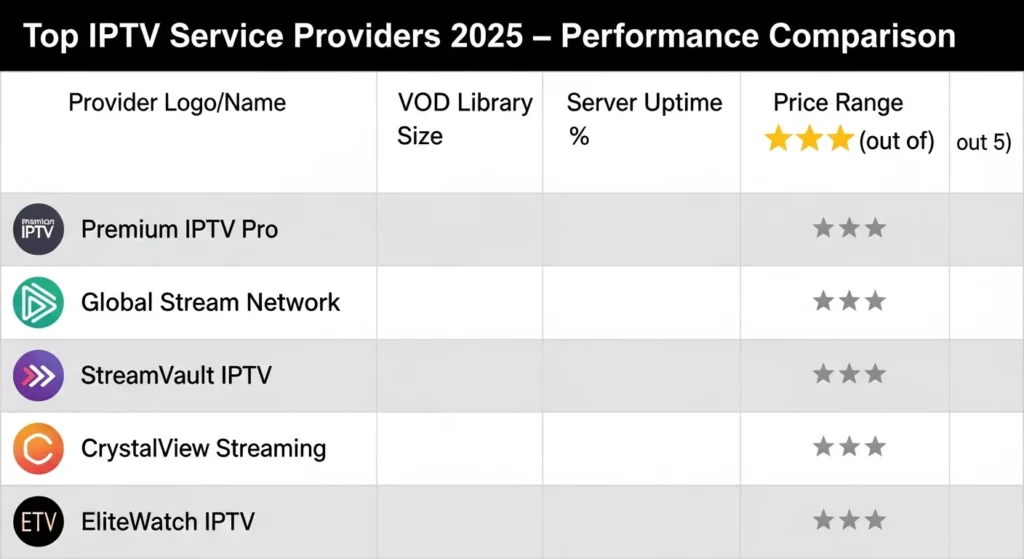
1. Premium IPTV Pro – 18,000+ channels, 45,000+ VOD titles, 4K streaming, 99.7% uptime, $15-20/month. Best for dedicated sports channels with multi-angle viewing.
2. Global Stream Network – 12,000+ channels with strong international coverage, 30,000+ VOD titles, 99.5% uptime, $12-18/month. Excellent EPG accuracy and 7-day catch-up TV.
3. StreamVault IPTV – 15,000+ channels including premium sports, 38,000+ VOD titles, 99.6% uptime, $14-22/month. Features 24/7 customer support with live chat.
4. CrystalView Streaming – 10,000+ quality-focused channels, 25,000+ curated VOD, buffer-free HD/FHD, 99.4% uptime, $10-15/month. Most budget-friendly with reliable performance.
5. EliteWatch IPTV – 20,000+ channels with extensive regional options, 50,000+ VOD including latest releases, 99.8% uptime, $18-25/month. Premium tier with exclusive content.
6. Velocity Streams – 8,000+ US/UK/Canadian channels, 20,000+ VOD titles, 99.3% uptime, $9-14/month. Perfect for North American viewers.
7. WorldView IPTV – 14,000+ channels covering 50+ countries, 35,000+ international films, 99.5% uptime, $13-19/month. Best for international and expatriate audiences.
8. SportsFocus IPTV – 7,000+ channels with 200+ dedicated sports channels, 15,000+ sports events, 99.6% uptime, $16-24/month. Specialized for sports enthusiasts.
9. FamilyStream Plus – 11,000+ channels with robust parental controls, 28,000+ family-friendly content, 99.4% uptime, $11-17/month. Multi-profile support with age restrictions.
10. BudgetView IPTV – 6,000+ essential channels, 18,000+ popular titles, 98.9% uptime, $7-12/month. Most affordable option with solid reliability.
All listed IPTV service providers offer free trials (24-48 hours) and flexible subscription periods.
Key Features to Look for in Reliable IPTV Service Providers
When evaluating IPTV service providers, prioritize these critical features:
Server Redundancy ensures that if one server experiences issues, your connection automatically switches to backup servers without interruption. Anti-Freeze Performance includes adaptive bitrate streaming that automatically adjusts video quality based on your connection speed.
24/7 Customer Support through multiple channels including live chat, email, and knowledge bases is essential. Response times should average under 2 hours for email and under 5 minutes for live chat.
EPG Accuracy should include daily or hourly updates with accurate program information, episode details, and artwork. Channel Quality Standards should meet minimum bitrates: 4K channels at 20+ Mbps, Full HD at 6-10 Mbps, HD at 3-5 Mbps.
Regional Channel Support varies by provider, with comprehensive services offering specialized packages for US/Canada, UK, Arabic, African, and Asian markets. Multi-Connection Options allow 2-5 simultaneous connections for household or commercial subscriptions.
Performance & Streaming Quality Benchmarks
Understanding technical performance metrics helps you evaluate IPTV service providers objectively:
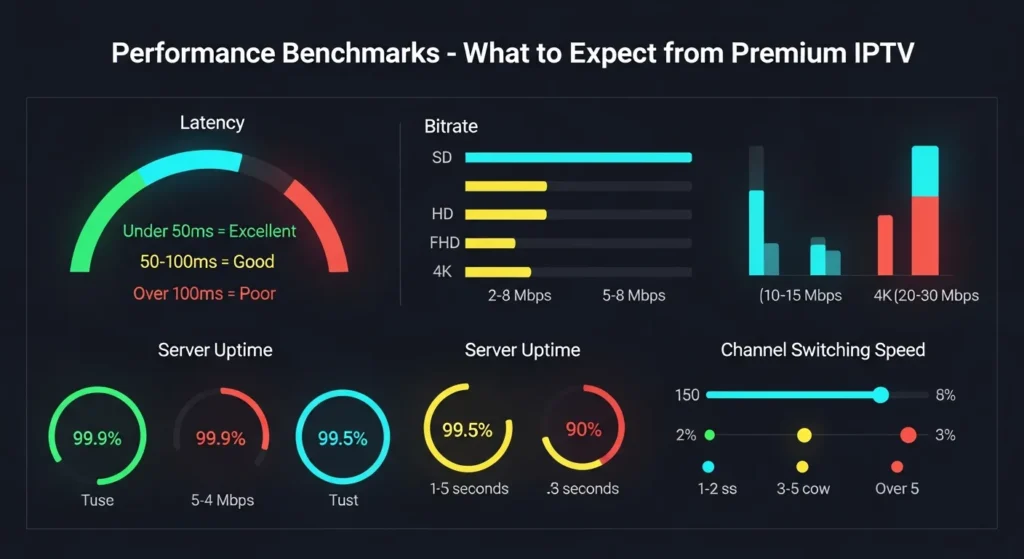
Latency Standards: Excellent services provide under 50ms server response time, good services 50-100ms, acceptable 100-200ms, while over 200ms is poor.
Bitrate Ranges: 4K/UHD requires 15-25 Mbps, Full HD needs 5-10 Mbps, HD requires 2.5-5 Mbps, and SD uses 1-2.5 Mbps.
Server Uptime Expectations: Premium services maintain 99.5-99.9% uptime (less than 4 hours downtime monthly), mid-range services 99.0-99.5%, and budget services 98.5-99.0%.
Channel Switching Speed: Instant switching (under 1 second) indicates premium CDN infrastructure, 1-3 seconds shows good optimization, 3-5 seconds is adequate, while over 5 seconds suggests poor performance.
Test IPTV service providers during peak hours (7-11 PM local time) when server loads are highest for accurate performance assessment.
Better Alternatives & Add-Ons for IPTV Users
IPTV Box Upgrades: For 4K content, invest in devices like Nvidia Shield TV Pro or Apple TV 4K supporting H.265 hardware decoding. For multi-room setups, consider MAG boxes or multiple Fire TV Stick 4K Max units.
Network Improvements: Upgrade to dual-band Wi-Fi 6 routers with MU-MIMO technology. Run Ethernet cables to critical viewing locations for consistent performance.
Recommended Apps: Beginners should use IPTV Smarters Pro, advanced users benefit from TiviMate Premium, and multi-device households appreciate XCIPTV Player’s easy configuration backup.
VPN Considerations: Most IPTV service providers operate effectively without VPNs. Use VPN services only if experiencing ISP throttling or accessing geo-restricted content.
Popular IPTV Use Cases in 2025
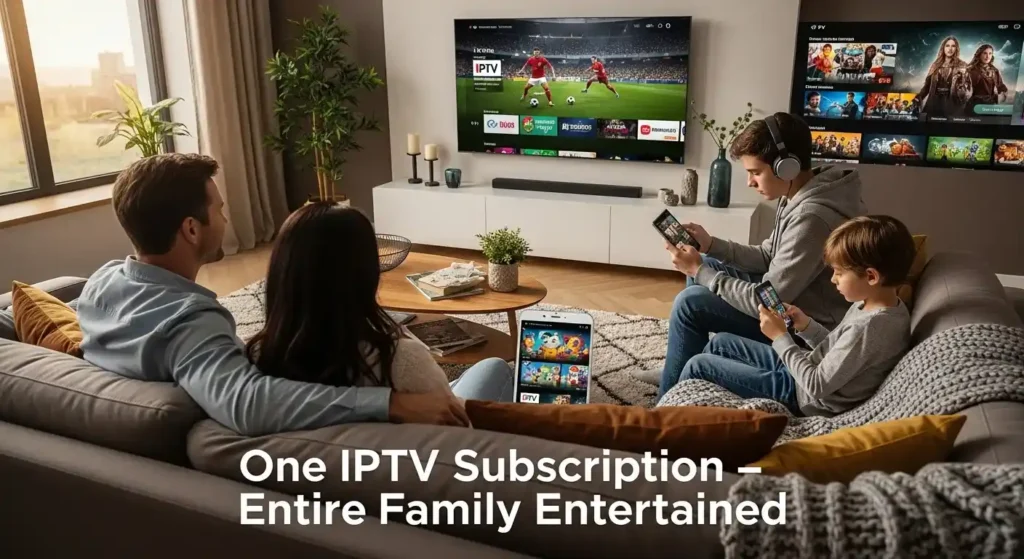
Home Entertainment: Families replace traditional cable with comprehensive IPTV subscriptions across 3-5 devices, enjoying extensive channel lineups and VOD libraries with significant cost savings.
International Streaming: Expatriates maintain connections to home-country programming through IPTV service providers specializing in regional content.
IPTV Reselling: Entrepreneurs build profitable businesses distributing IPTV subscriptions with wholesale providers offering reseller panels, white-label apps, and volume pricing.
Hotels and Hospitality: Commercial installations provide customized channel lineups, in-room services, and centralized management.
Sports Bars: Commercial venues display multiple simultaneous sports events with multi-screen licenses and high-reliability service level agreements.
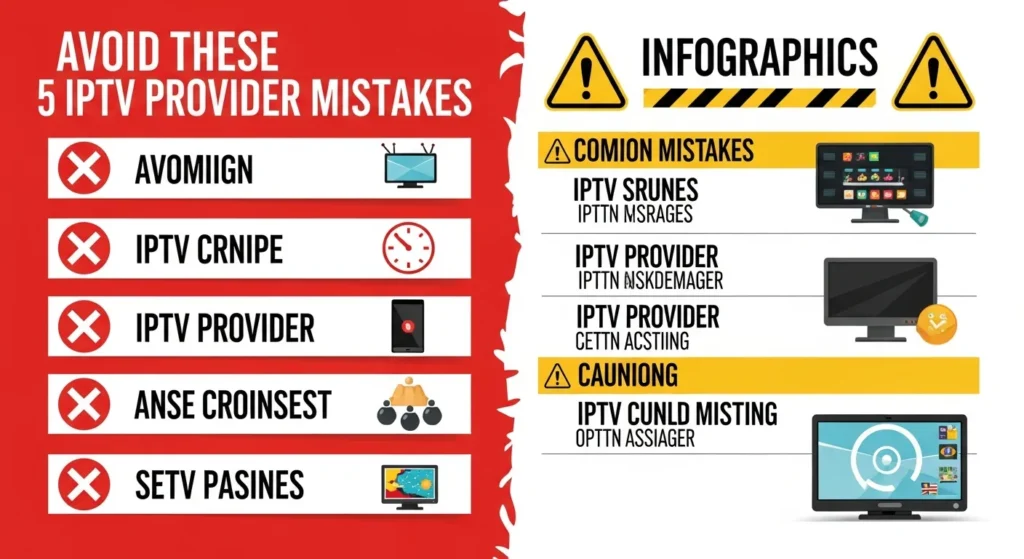
Common Mistakes When Choosing IPTV Service Providers
Buying from Unknown Providers: Never purchase from unverified IPTV service providers without researching reputation. Scam operations collect payments, provide brief service, then disappear.
Fix: Research providers on Reddit communities, independent review sites, and forums. Always test free trials before committing to long-term subscriptions.
Using Low-Speed Wi-Fi: Single-band 2.4GHz routers struggle with HD streams, especially with multiple household devices competing for bandwidth.
Fix: Upgrade to dual-band routers on 5GHz frequencies. Use Ethernet connections for 4K streaming.
Overlooking Server Location: Geographic distance between servers and your location directly impacts latency and streaming quality.
Fix: Select IPTV service providers with server presence in your region or continent.
Not Testing Free Trials: Committing to multi-month subscriptions without testing represents unnecessary risk.
Fix: Always evaluate channel quality during peak evening hours, test VOD playback, and verify EPG accuracy during trials.
Focusing on Channel Count: Marketing claims of “25,000+ channels” often mislead buyers—most users watch 50-100 channels maximum.
Fix: Evaluate channel quality over quantity. Review actual channel lists focusing on channels you’ll genuinely watch.
Maintenance, Account Security & Long-Term Tips
App Cache Management: Clear app cache weekly to prevent performance degradation, slower loading times, and playback issues.
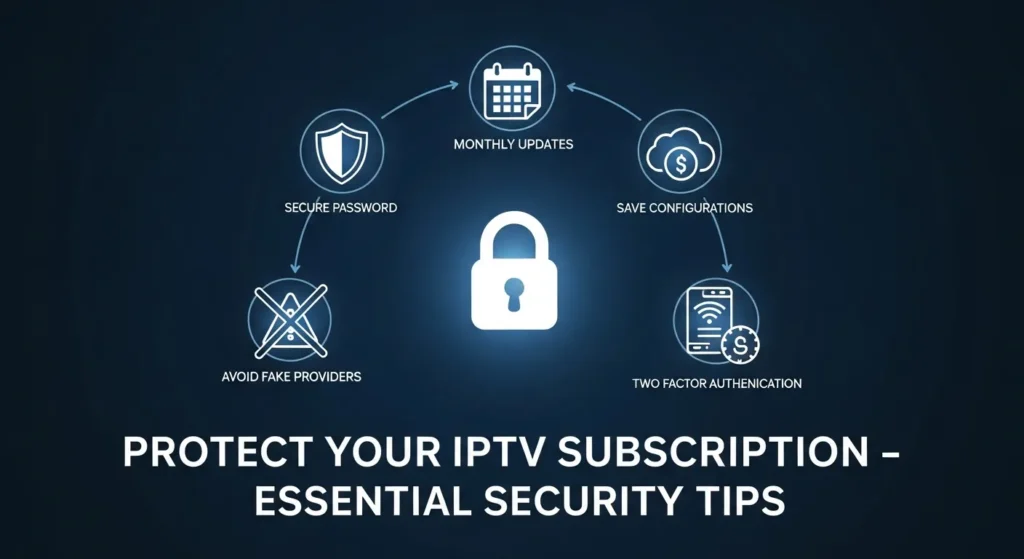
Playlist Updates: Check provider communications monthly for M3U URL or Xtream Codes updates. Set calendar reminders to verify playlists.
Avoiding Scams: Recognize red flags including prices significantly below market rates, payment only through cryptocurrency, no trial offers, aggressive marketing with unrealistic promises, and poor website design.
Secure Renewal Practices: Use unique passwords for IPTV accounts different from other online services. Enable two-factor authentication if available. Save subscription confirmations in password managers.
Configuration Backup: Export app settings, playlists, favorites, and EPG configurations monthly. Store backups securely in cloud storage for quick restoration.
Legal Awareness: IPTV legality varies by jurisdiction and content licensing. Choose providers operating legally with verifiable business registrations and transparent operations.
Cost Optimization: After successfully testing monthly service for 2-3 months, consider upgrading to longer plans offering 15-30% savings.
Conclusion
Choosing reliable IPTV service providers in 2025 requires balancing technical performance, content variety, customer support, and pricing. The IPTV industry has matured significantly, offering consumers unprecedented access to global entertainment at a fraction of traditional cable costs. Success depends on selecting providers with robust server infrastructure, anti-freeze technology, and proven uptime records.
Prioritize server stability over channel quantity, test services thoroughly before committing, and maintain proper device configurations for optimal performance. Ready to switch to a smoother streaming experience? Explore the top IPTV service providers today and enjoy buffer-free entertainment. Share your IPTV experiences in the comments below, and subscribe for more expert insights on streaming technology!
FAQs
Q1: Are IPTV service providers legal?
IPTV technology itself is completely legal. However, the legality of specific IPTV service providers depends on content licensing compliance in your jurisdiction. Legitimate providers obtain broadcasting rights through proper licensing agreements with content owners. To ensure compliance, choose IPTV service providers with transparent business registrations, verifiable company information, and professional operations.
Q2: How many devices can I use with one subscription?
Device allowances vary among IPTV service providers. Standard subscriptions typically support 1-2 simultaneous connections, family plans offer 3-5 connections, and premium subscriptions may support 5-10+ connections. “Device support” differs from “simultaneous connections”—you might install apps on unlimited devices, but only the specified number can stream actively at once.
Q3: What is the difference between M3U and Xtream Codes?
M3U is a simple playlist file containing direct URLs to streaming channels, offering universal compatibility but limited functionality. Xtream Codes API is a sophisticated protocol offering enhanced functionality through username/password authentication, enabling integrated EPG data, VOD libraries, catch-up TV, and automatic updates. Most premium IPTV service providers offer both formats.
Q4: Why does IPTV buffer sometimes?
IPTV buffering occurs due to insufficient internet speed, server overload during high traffic, Wi-Fi interference, ISP throttling, or geographic distance from servers. Solutions include upgrading internet plans, switching to 5GHz Wi-Fi or Ethernet, testing alternative servers, increasing app buffer settings, and avoiding peak usage times.
Q5: What is the best app for IPTV in 2025?
The best app depends on your device and requirements. IPTV Smarters Pro works best for beginners across all platforms. TiviMate excels for Android users seeking advanced customization. XCIPTV Player offers simple QR code setup with cross-platform support. Perfect Player provides lightweight performance for limited-resource devices. VLC Media Player serves as a reliable fallback for basic M3U playback.